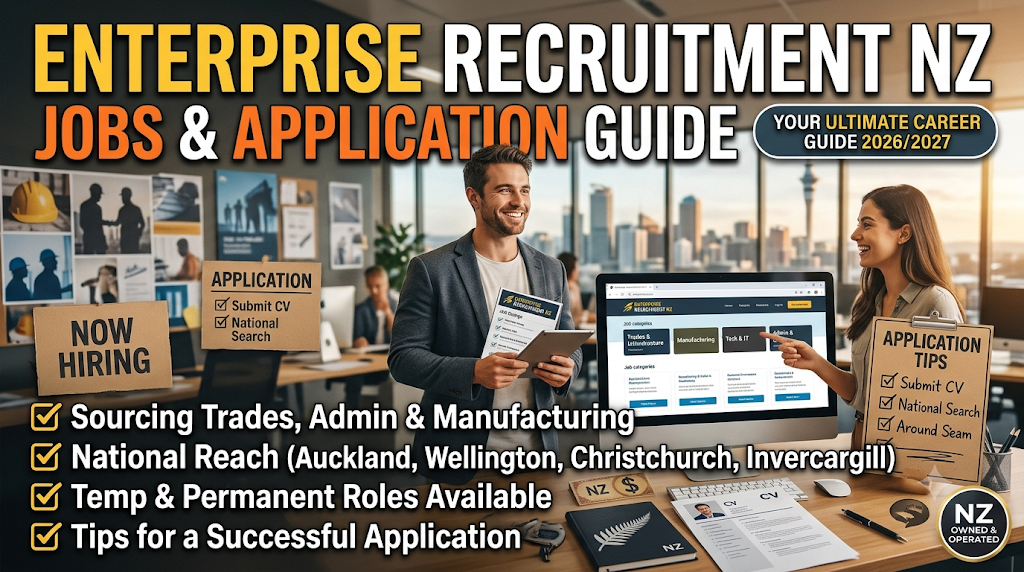
Searching for Enterprise Recruitment NZ jobs can be a useful way to find temporary, permanent and contract employment across New Zealand.
Enterprise Recruitment is a New Zealand recruitment agency that connects job seekers with employers in areas such as manufacturing, engineering, warehousing, logistics, construction, administration, technical services and other skilled industries.
The application process is usually straightforward, but a strong CV, accurate work history and clear communication can improve your chances of being contacted by a recruiter.
This guide explains how to search for available roles, prepare your application, work with a recruitment consultant and avoid common job-search mistakes.
Important: Job vacancies, locations, salary details and application requirements can change. Always confirm current information through the official Enterprise Recruitment website or the specific job advertisement.
What Is Enterprise Recruitment?
Enterprise Recruitment is a New Zealand recruitment company that works with employers seeking workers for different types of roles.
Recruitment agencies may help employers with:
- Candidate sourcing
- CV screening
- Interviews
- Reference checks
- Temporary staffing
- Permanent recruitment
- Contract placements
- Skilled-trade recruitment
- Workforce planning
For job seekers, a recruitment agency can provide access to vacancies that may not be widely advertised elsewhere.
Types of Enterprise Recruitment NZ Jobs
Available roles vary by branch, region, employer demand and season. Common job categories may include the following.
| Job Category | Examples |
|---|---|
| Manufacturing | Production worker, machine operator, assembly worker |
| Engineering | Maintenance technician, mechanical fitter, design or technical support |
| Warehousing | Storeperson, picker-packer, inventory assistant |
| Logistics | Class 2–5 driver, dispatch coordinator, freight worker |
| Construction | Labourer, carpenter, site support worker |
| Trades | Welder, fabricator, electrician, plumber or mechanical trade roles |
| Administration | Receptionist, office administrator, data-entry worker |
| Customer service | Call-centre worker, service coordinator, support representative |
| Technical roles | Technician, quality-control worker, maintenance specialist |
| Management | Team leader, supervisor, operations coordinator |
The requirements differ widely. Some vacancies may provide on-the-job training, while others require experience, licences, qualifications or industry certification.
Where Enterprise Recruitment Operates
Enterprise Recruitment has historically recruited for employers in several New Zealand regions, including major centres and industrial locations.
Depending on current operations, vacancies may be available in or near:
- Auckland
- Christchurch
- Wellington
- Hamilton
- Tauranga
- Dunedin
- Invercargill
- Palmerston North
- Other regional employment centres
Do not assume that every branch recruits for the same occupations. Local demand can differ significantly between regions.
For example:
- Auckland may have more warehouse, logistics, manufacturing and technical vacancies.
- Christchurch may offer engineering, construction and manufacturing roles.
- Hamilton may have opportunities in industrial, agricultural and distribution businesses.
- Wellington may provide more administration, technical support and service-based positions.
- Regional centres may have stronger demand for trades, drivers and production workers.
How to Search for Enterprise Recruitment NZ Jobs
1. Visit the official website
Begin with the official Enterprise Recruitment website and look for the jobs, vacancies or job-search section.
Use filters such as:
- Location
- Job category
- Employment type
- Salary
- Experience level
- Full-time or part-time status
- Temporary or permanent work
Always verify that you are using the genuine company website before submitting personal information.
2. Search by job title
Instead of searching only for Enterprise Recruitment NZ jobs, try specific terms such as:
- Warehouse jobs
- Production worker
- Maintenance technician
- Class 4 driver
- Welder
- Fabricator
- Office administrator
- Mechanical fitter
- Forklift operator
- Customer service representative
Specific searches often produce more relevant results.
3. Register with the agency
Some recruitment agencies allow candidates to create a profile or submit a CV for future opportunities.
When registering, provide accurate information about:
- Work history
- Availability
- Location
- Preferred job type
- Licences
- Qualifications
- Pay expectations
- Right to work in New Zealand
A recruiter can only match you effectively if your profile is complete and current.
4. Set job alerts
If the website offers alerts, choose the locations and categories that match your experience.
Avoid selecting every category if you are applying for specialist work. Highly targeted alerts can make it easier to respond quickly to suitable vacancies.
5. Check the closing date
Some vacancies remain online after a suitable candidate has been found. Apply as soon as possible, especially for roles with a clear closing date or immediate start.
How to Prepare Your CV
A recruiter may review many applications for one vacancy, so your CV should be clear and easy to scan.
Include:
- Full name and contact details
- Location
- Short professional summary
- Employment history
- Key responsibilities
- Achievements where relevant
- Licences and certifications
- Education and training
- Technical skills
- Availability
- References if requested
Example professional summary
Reliable warehouse and logistics worker with four years of experience in picking, dispatch, inventory control and forklift operations. Holds a current forklift certificate, has a strong safety record and is available for full-time shift work in Christchurch.
Tailor the summary to the role. A production worker should not submit the same opening statement as an office administrator.
What to Highlight for Different Roles
| Target Role | Experience to Emphasise |
|---|---|
| Warehouse worker | Picking, packing, stock control and dispatch |
| Forklift operator | Licence, equipment experience and safety record |
| Driver | Licence class, routes, delivery records and compliance |
| Production worker | Assembly, quality checks and shift work |
| Welder | Welding processes, materials and workshop experience |
| Maintenance technician | Fault-finding, preventive maintenance and machinery |
| Administrator | Software, customer service and organisation |
| Team leader | Staff coordination, reporting and performance support |
Use specific examples instead of general claims. Reduced dispatch errors by checking orders before loading is stronger than good attention to detail.
Cover Letters and Application Statements
Not every recruitment vacancy requires a cover letter, but a short application statement can help explain your suitability.
A useful application should mention:
- The role you are applying for.
- Your relevant experience.
- Your availability.
- Your location or willingness to relocate.
- Relevant licences or qualifications.
- Why the role interests you.
Keep the message concise and proofread it before submitting.
Licences and Qualifications That May Help
Many Enterprise Recruitment NZ jobs require practical skills rather than university degrees. However, relevant licences can improve your chances.
Potentially useful credentials include:
- Forklift certificate
- Full New Zealand driver licence
- Class 2, 4 or 5 licence
- Site Safe or workplace safety training
- First-aid certificate
- Welding or fabrication qualification
- Electrical registration
- Trade certificate
- Working-at-heights training
- Confined-spaces training
- Computer or administration certificates
Only list current and valid licences. If a qualification is from overseas, explain whether it has been recognised or converted for use in New Zealand.
Work Rights in New Zealand
Applicants should be legally entitled to work in New Zealand.
Depending on your circumstances, you may need:
- New Zealand citizenship
- Permanent residence
- A valid work visa
- An employer-specific work condition
- Evidence of work rights
Recruiters may request proof before placing you with an employer. Do not misrepresent your immigration status.
If you are unsure whether your visa permits the job, check Immigration New Zealand guidance before applying.
What to Expect After Applying
The recruitment process may involve several stages.
Initial screening
A recruiter may contact you by phone or email to confirm:
- Your experience
- Availability
- Location
- Pay expectations
- Work rights
- Transport
- Shift preferences
Interview
The interview may be conducted by phone, video call or in person. Prepare examples of your previous work and explain how you handled safety, teamwork and difficult situations.
Skills or licence checks
Technical jobs may require:
- Practical assessment
- Licence verification
- Qualification checks
- Medical assessment
- Drug and alcohol testing
- Police or background checks
The requirements depend on the role and employer.
Reference checks
Keep contact details for previous supervisors or managers. Ask your referees for permission before listing them.
Employer interview
The recruitment consultant may introduce you to the hiring company. This meeting could focus on technical ability, cultural fit, availability and workplace expectations.
Common Interview Questions
Prepare answers for questions such as:
- Tell me about your previous experience.
- Why are you interested in this position?
- What machinery or software have you used?
- What safety procedures do you follow?
- How do you manage repetitive or physically demanding work?
- Tell me about a workplace problem you solved.
- Are you comfortable with shifts?
- When can you start?
- What pay range are you seeking?
- Do you have reliable transport?
- What type of role are you looking for?
Use the STAR method for competency questions:
- Situation: Explain the context.
- Task: Describe your responsibility.
- Action: Explain what you did.
- Result: State the outcome.
Temporary, Contract and Permanent Roles
Recruitment agencies may offer several employment arrangements.
| Employment Type | Description |
|---|---|
| Temporary | Work for a limited period or while an employer needs additional staff |
| Temp-to-permanent | Begin temporarily with the possibility of permanent employment |
| Fixed-term | Employment for a defined period or project |
| Contract | Work under agreed terms for a specific assignment |
| Permanent | Ongoing employment with the hiring company |
| Casual or variable hours | Hours may change according to business demand |
Read the employment agreement carefully. Confirm who your employer is, how you are paid, expected hours and notice requirements.
How to Improve Your Chances
Keep your details updated
Tell the recruiter when you change phone number, location, availability or visa status.
Respond promptly
Recruitment opportunities can move quickly. Check your phone, email and voicemail regularly.
Be honest about your experience
Do not claim licences, qualifications or skills you do not have. Employers may verify your information.
Be flexible where possible
Being open to shift work, temporary assignments or nearby locations can increase your opportunities.
Prepare for workplace safety
Show that you understand basic safety expectations, personal protective equipment and reporting procedures.
Build a professional relationship
A recruiter may contact you about future roles. Be polite, punctual and clear even if one application is unsuccessful.
Salary and Pay Expectations
Pay varies by:
- Occupation
- Skill level
- Location
- Industry
- Shift pattern
- Overtime
- Contract type
- Licence requirements
- Experience
- Collective agreements
Avoid relying on a salary range from an old listing. Ask whether the advertised rate is:
- Hourly or annual
- Before tax
- Inclusive of holiday pay
- Inclusive of allowances
- Inclusive of overtime
- A starting rate or maximum rate
Also ask about breaks, shift allowances, travel reimbursement and other employment conditions.
Common Application Mistakes
Avoid these errors when applying for Enterprise Recruitment NZ jobs:
- Submitting an outdated CV
- Using an unclear file name
- Applying without reading the job requirements
- Forgetting to mention licences
- Providing inaccurate availability
- Ignoring recruiter messages
- Arriving late to an interview
- Giving vague answers
- Listing irrelevant experience
- Failing to check work-right requirements
- Accepting a role without reading the agreement
A professional application does not need to be complicated. It needs to be accurate, relevant and easy to understand.
Avoiding Recruitment Scams
Use caution if someone claims to represent a recruitment company and:
- Requests money before arranging work
- Guarantees a job without an interview
- Uses an unofficial email address
- Requests bank details too early
- Sends suspicious links or attachments
- Pressures you to make an immediate payment
- Offers unusually high pay for little experience
Verify contact details through the official Enterprise Recruitment website. Never pay a recruiter to secure a genuine job unless you have independently confirmed the arrangement and legal basis for the charge.
Frequently Asked Questions
How do I apply for Enterprise Recruitment NZ jobs?
Search current vacancies through the official Enterprise Recruitment website, select a suitable role and follow the application instructions. You may need to submit a CV, create a candidate profile or contact a recruitment consultant.
Does Enterprise Recruitment offer temporary work?
Recruitment agencies commonly handle temporary, fixed-term, contract and permanent placements. The available employment types depend on current employer demand.
What jobs are available through Enterprise Recruitment?
Vacancies may include manufacturing, warehousing, logistics, engineering, trades, construction, administration, technical and customer-service roles. Available positions change regularly.
Do I need a university degree?
Many practical and technical roles do not require a university degree. They may require work experience, a trade qualification, licence, certificate or practical assessment instead.
Can migrants apply for Enterprise Recruitment NZ jobs?
You can apply if you have the legal right to work in New Zealand and meet the employer’s requirements. You may be asked to provide evidence of your visa or work rights.
How long does the application process take?
The timeframe varies according to the job, employer, urgency and screening requirements. Temporary roles may move quickly, while technical or permanent appointments may involve several interviews and checks.
Should I apply for more than one vacancy?
Yes, provided each role matches your experience and availability. Tailor your CV or application message rather than sending the same generic application everywhere.
What should I bring to an interview?
Bring identification if requested, copies of relevant licences or certificates, your availability details and examples of your previous work. Arrive early and dress appropriately for the role.
Conclusion
Applying for Enterprise Recruitment NZ jobs can provide access to a wide range of temporary, contract and permanent opportunities across New Zealand.
The strongest applications are accurate, targeted and supported by relevant experience, licences and clear availability. Prepare a concise CV, verify your work rights, respond promptly to recruiters and research the employer before attending an interview.
Whether you are looking for warehouse work, engineering employment, a trade position, administration or a technical role, recruitment agencies can help connect your skills with current employer demand. Always confirm job details through official channels and read the employment agreement before accepting an offer.