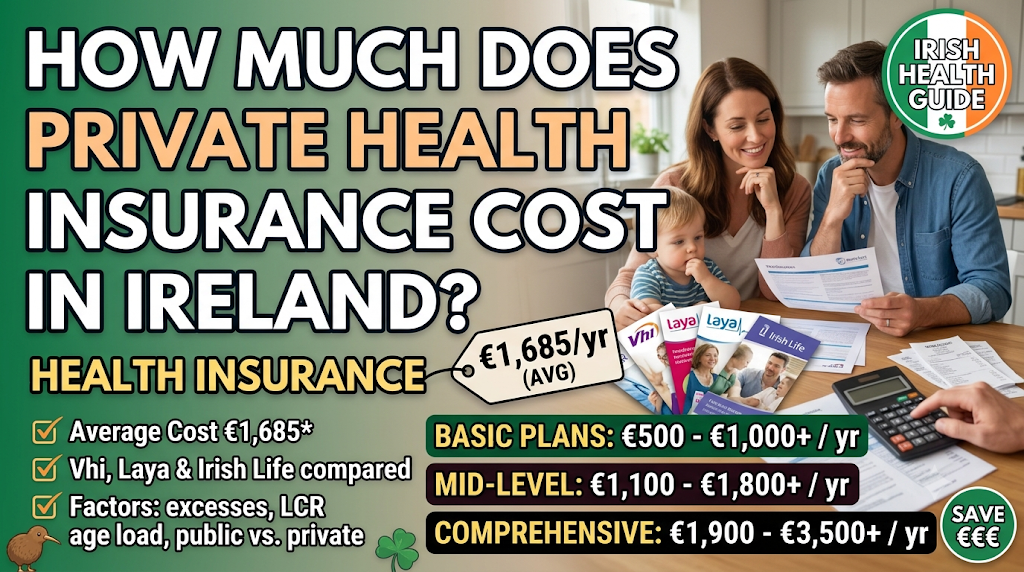
The private health insurance cost in Ireland depends on your age, cover level, hospital access, excess, outpatient benefits and whether you qualify for a group scheme.
As a broad guide, the latest market information available in 2026 places the average adult premium at approximately €1,960 per year, or about €163 per month, after tax relief at source. However, individual plans can cost considerably less or more.
Basic hospital plans may cost several hundred euro per adult each year, while comprehensive plans with wider private-hospital access and extensive outpatient benefits can cost several thousand euro annually.
Important: Insurance prices and benefits change regularly. Treat the figures in this guide as general indications, not personal quotations. Check the Health Insurance Authority comparison tool and the insurer’s current policy documents before buying or renewing cover.
Average Private Health Insurance Costs in Ireland
The following ranges provide a general guide to annual premiums.
| Cover Type | Indicative Annual Cost per Adult | Typical Features |
|---|---|---|
| Basic hospital cover | Approximately €500–€900 | Public hospitals, limited private access or higher excess |
| Mid-range cover | Approximately €1,000–€1,800 | More hospital options and selected outpatient benefits |
| Comprehensive cover | Approximately €1,800–€3,500+ | Wider hospital access, lower excesses and additional benefits |
| Family cover | Approximately €2,000–€5,000+ | Depends on the number and age of adults and children |
| Premium specialist plans | €3,500+ per adult in some cases | Broad benefits and lower cost-sharing |
These are broad market ranges rather than guaranteed prices. Two plans with similar names may have very different hospital lists, exclusions, excesses and outpatient limits.
What Is the Average Cost?
The Health Insurance Authority’s market statistics, reported through 2026, indicate an average adult premium of approximately €1,960 per year in Q1 2026.
That works out at roughly:
- €163 per month
- €980 every six months
- €1,960 per year
This is an average across the market. It does not mean that every adult pays this amount. Younger customers on basic plans may pay much less, while people choosing extensive cover may pay considerably more.
The average can also change when insurers adjust prices, introduce new plans or alter benefits.
How Much Does Health Insurance Cost for a Family?
Family premiums depend on:
- Number of adults
- Number and age of children
- Cover level
- Hospital access
- Excesses
- Outpatient benefits
- Maternity cover
- Existing group discounts
Children’s premiums are generally lower than adult premiums under Ireland’s community-rating rules. However, a family with two adults on comprehensive plans can still face a substantial annual bill.
A general planning range might be:
| Household | Broad Annual Planning Range |
|---|---|
| One adult | €700–€3,500+ |
| Two adults | €1,400–€7,000+ |
| One adult and one child | €1,000–€4,500+ |
| Two adults and two children | €2,000–€8,000+ |
These figures are not quotations. They are budgeting ranges only, and the actual price may differ significantly.
What Does Private Health Insurance Cover?
A private health insurance policy can include some combination of:
- Inpatient hospital treatment
- Day-case procedures
- Private or semi-private hospital accommodation
- Consultant fees
- Certain scans and diagnostic tests
- Outpatient consultations
- Physiotherapy
- Mental-health services
- Maternity benefits
- Emergency treatment
- Access to selected private hospitals
Cover depends entirely on the policy. Some low-cost plans may have limited access to private hospitals or high excesses for certain procedures.
Do not compare plans by price alone. Check the benefit table, hospital list, exclusions and waiting periods.
Main Factors Affecting the Premium
1. Level of hospital cover
Hospital cover is one of the biggest factors affecting the private health insurance cost in Ireland.
A basic policy may provide access mainly to public hospitals or selected facilities. A more comprehensive policy may cover private hospitals, but it may also include higher premiums, excesses or procedure restrictions.
2. Excesses
An excess is the amount you pay yourself when making a claim or receiving a particular treatment.
For example, a policy may include:
- €100 excess per admission
- €250 excess per claim
- Separate excesses for private hospitals
- Different excesses for day-case and inpatient treatment
A higher excess can reduce your premium, but make sure you could afford it if you need treatment.
3. Outpatient benefits
Some policies provide partial refunds for:
- GP visits
- Consultant appointments
- Physiotherapy
- Dental treatment
- Optical care
- Prescription costs
These benefits often have annual limits and may refund only a percentage of the expense. A plan with extensive outpatient cover may cost more than a hospital-only policy.
4. Hospital lists
Not every plan provides access to every private hospital. Some policies exclude certain facilities or pay lower benefits for treatment in particular hospitals.
Before purchasing, check whether the policy covers hospitals you would realistically use, such as facilities near your home or workplace.
5. Age and Lifetime Community Rating
Ireland uses community rating, meaning insurers generally cannot price a policy based directly on your individual health risk.
However, Lifetime Community Rating can increase the premium for people buying inpatient health insurance for the first time at age 35 or older, or after a qualifying break in cover.
The loading generally starts at 2% for each year over age 34 and can reach a maximum of 70%. For example, someone buying cover for the first time at age 45 may face a 22% loading, subject to the applicable rules.
Check the Health Insurance Authority’s current guidance because exemptions may apply, including certain circumstances involving recent residence in Ireland.
6. Group schemes
Employer or professional group schemes may offer discounts of up to 10% in some cases. The available saving depends on the scheme and insurer.
Before joining a group plan, compare:
- Annual premium
- Hospital list
- Benefits
- Excesses
- Renewal terms
- Whether dependants can join
- What happens when employment ends
A group scheme is not automatically the best option if its benefits are unsuitable.
Tax Relief at Source
Private health insurance premiums in Ireland normally include tax relief at source, often known as TRS. This means the tax relief is generally applied before you pay the premium rather than claimed later through a tax return.
The exact relief and applicable limits depend on current Revenue rules.
When comparing prices, check whether the quoted figure is:
- Before tax relief
- After tax relief
- Monthly or annual
- For one person or the entire household
- Inclusive of any promotional discount
This prevents misleading comparisons between plans.
Is Private Health Insurance Required in Ireland?
Most people do not need private health insurance to access Ireland’s public health service.
Private health insurance may provide:
- Greater choice of hospital
- Access to private or semi-private accommodation
- Potentially faster access for some services
- Cover for certain treatment costs
- Additional outpatient benefits
However, it does not guarantee immediate treatment, a particular consultant or complete coverage of every medical expense.
Some immigration permissions may require proof of health insurance. If you are moving to Ireland, check the requirements that apply to your immigration permission.
Public Healthcare Without Private Insurance
People without private insurance can still use the public healthcare system, subject to applicable eligibility rules and charges.
Before deciding not to take out insurance, investigate:
- Public hospital charges
- GP fees
- Prescription costs
- Consultant expenses
- Diagnostic testing
- Waiting times
- Your eligibility for public schemes
- Whether your employer provides cover
The decision depends on your finances, healthcare preferences, age, family circumstances and tolerance for potential out-of-pocket costs.
How to Reduce the Cost of Health Insurance
Compare every year
Insurers change premiums and benefits regularly. Do not automatically renew without checking whether another plan provides similar cover at a lower price.
Use the Health Insurance Authority’s comparison tool and compare the exact benefits, not just plan names.
Consider a higher excess
A higher excess may reduce the annual premium. This can make sense if you have savings and do not expect frequent claims.
Calculate the difference:
- Annual premium saving
- Likely excess
- Number of expected claims
- Maximum possible out-of-pocket cost
Review outpatient benefits
If you rarely claim for GP visits, dental care or physiotherapy, a plan with limited outpatient cover may be more cost-effective.
However, do not remove benefits you are likely to need. A cheaper plan is not useful if it excludes important treatment.
Check hospital access
You may not need the most expensive plan if you are satisfied with public hospitals and selected private facilities. Compare the hospital list carefully before downgrading.
Use an employer scheme
If your employer offers a group plan, compare it with individual policies. Confirm whether dependants can be added and what happens when you leave the company.
Pay annually where practical
Some insurers may offer different payment options. Check whether monthly payments carry additional charges or whether annual payment is cheaper.
Switching Insurers
You can usually switch insurers, but timing matters. Before changing, check:
- Renewal date
- Waiting periods
- Existing medical conditions
- Benefits being reduced
- Hospital restrictions
- Excesses
- Breaks in cover
- Whether your new policy starts immediately
The HIA states that switching to an equivalent level of cover may allow some waiting periods to be waived, but upgrading cover can create new waiting periods for the additional benefits.
Do not cancel your old policy until you understand when the new policy begins.
Waiting Periods
New customers may have to serve waiting periods before receiving full cover.
Waiting periods may apply when:
- You buy health insurance for the first time
- Your previous cover ended more than 13 weeks earlier
- You upgrade to a higher level of cover
- You add benefits not included in your previous plan
Emergency treatment for accidents and injuries may be treated differently. Check the exact policy terms and HIA guidance.
Questions to Ask Before Buying
Ask the insurer or broker:
- Which hospitals are included?
- What excess applies to admissions?
- Are private rooms covered?
- Are consultant fees fully covered?
- Are scans and diagnostic tests included?
- What outpatient benefits are available?
- Are there annual limits?
- Are maternity benefits included?
- Are existing conditions subject to waiting periods?
- What happens if I switch plans?
- Is the quoted premium before or after tax relief?
- Can dependants join the policy?
Request the policy documents in writing and read the exclusions carefully.
Common Mistakes
Choosing the cheapest plan without checking benefits
Low-cost plans may have limited hospital access or high excesses.
Assuming all private hospitals are covered
Hospital lists differ between plans. Check the exact policy.
Ignoring waiting periods
Insurance may not provide immediate cover for every treatment.
Forgetting about policy changes
A plan can change at renewal. Review the updated benefit table each year.
Confusing health insurance with travel insurance
Travel insurance generally covers emergencies during a trip. It is not a substitute for Irish private health insurance.
Failing to compare like with like
Compare hospital access, excesses, limits and exclusions—not just the headline premium.
Frequently Asked Questions
How much does private health insurance cost in Ireland?
The average adult premium was approximately €1,960 per year in Q1 2026, according to market information reported through the Health Insurance Authority. Actual premiums range widely depending on cover, age, excesses and hospital access.
What is the cheapest private health insurance in Ireland?
Basic hospital plans may cost several hundred euro per adult annually, but the cheapest policy is not necessarily the best value. Check its hospital list, excesses, exclusions and waiting periods.
Is private health insurance worth it in Ireland?
It may be worthwhile if you value private hospital access, additional choice or outpatient benefits. The decision depends on your budget, healthcare needs and expectations about the public system.
Can I get health insurance after age 35?
Yes. However, Lifetime Community Rating may increase the premium if you buy inpatient cover for the first time after age 34 or have a qualifying break in cover.
Do children cost less to insure?
Children’s premiums are generally lower than adult premiums under community-rating rules. The exact amount depends on the policy and insurer.
Does private health insurance cover GP visits?
Some policies provide partial refunds for GP visits, but others focus mainly on hospital treatment. Check the outpatient benefits and annual limits.
Can I switch health insurers without new waiting periods?
Equivalent cover may allow waiting periods to be waived, but new waiting periods may apply when you upgrade benefits. Confirm the rules with the new insurer before cancelling existing cover.
Where can I compare Irish health insurance plans?
The Health Insurance Authority provides an official comparison tool. You should also review current policy documents and obtain a direct quotation from the insurer.
Conclusion
The private health insurance cost in Ireland can range from several hundred euro to several thousand euro per adult each year. In 2026, the average adult premium was approximately €1,960 annually, but your actual price will depend on the plan and your circumstances.
Compare hospital access, excesses, outpatient benefits, waiting periods, tax relief and renewal prices before making a decision. A basic policy may be suitable for someone who mainly wants hospital protection, while a comprehensive plan may appeal to people seeking broader private access and additional benefits.
Use the Health Insurance Authority comparison tool, read the policy documents carefully and review your cover at every renewal.