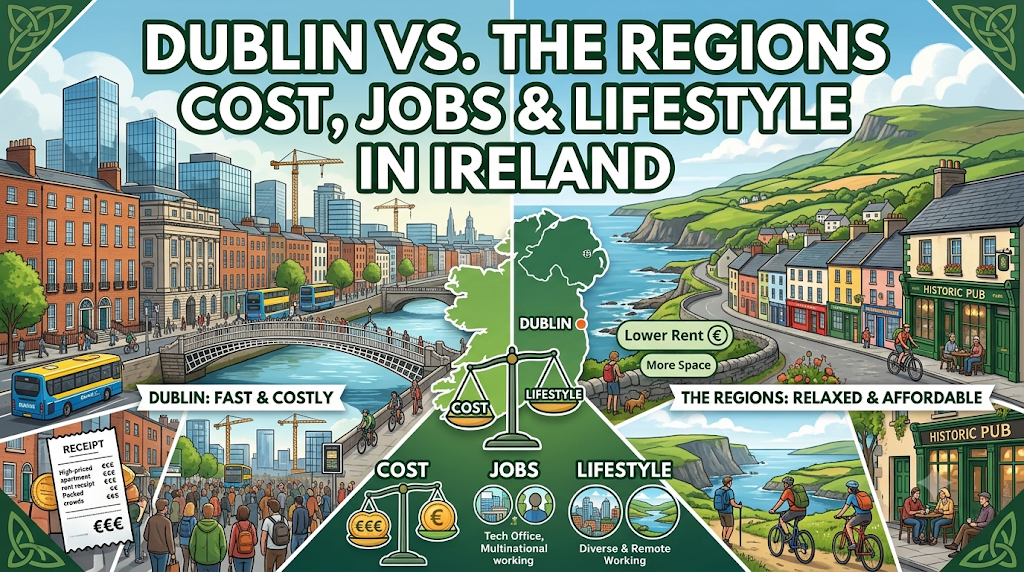
The differences between Dublin and other Irish regions can affect nearly every part of daily life, from housing and commuting to employment, entertainment and access to services.
Dublin is Ireland’s largest urban centre and a major hub for technology, finance, education, healthcare, government and international business. Other regions offer a wider range of lifestyles, including smaller cities, regional towns, coastal communities and rural areas.
Neither option is automatically better. Dublin may offer more jobs, public transport and cultural activities, while regional Ireland may provide more space, quieter surroundings and lower housing costs in some locations.
The best choice depends on your income, work arrangements, household size, transport needs and personal priorities.
Important: Costs and availability vary significantly by county, town, neighbourhood and property type. Rental and housing figures change over time, so check current official data and live listings before making a relocation decision.
1. Dublin Is More Urban and Densely Populated
Dublin has a much larger urban population and a higher concentration of employers, universities, cultural venues and public services than most other parts of Ireland.
According to the Central Statistics Office, approximately 1.6 million people lived in the Dublin region in April 2026, representing about 28.9% of Ireland’s population.
This concentration creates both opportunities and challenges.
Dublin advantages
- More employment sectors
- Larger university and college network
- Extensive public transport compared with most regions
- Greater choice of restaurants, venues and cultural events
- More specialist healthcare and professional services
- Larger communities for international residents
Dublin challenges
- Higher housing demand
- Greater competition for rental properties
- Traffic congestion
- Smaller homes for the same budget in many locations
- More noise and crowded public spaces
- Higher cost for some leisure and convenience services
Outside Dublin, the pace of life is often slower, but employment and services may be more dispersed.
2. Housing Costs Are Usually the Biggest Difference
Housing is one of the most important differences between Dublin and other Irish regions.
Dublin generally has stronger demand because it contains a large share of national employment, education and population growth. This can result in higher rents and more competition for available homes.
The Residential Tenancies Board’s Q1 2026 Rent Index reported a national standardised average rent for new tenancies of €1,839 per month. It also reported a standardised average of €1,651 for one-bedroom apartments nationally. These are national figures, not a direct Dublin-versus-every-county comparison.
Regional prices can be lower than Dublin, but this is not consistent across every town. Cork, Galway, commuter areas and popular coastal locations may also have strong demand.
Housing comparison
| Housing Factor | Dublin | Other Irish Regions |
|---|---|---|
| Rental demand | Usually very high | Varies significantly |
| Property choice | More listings overall, but strong competition | Fewer listings in some towns |
| Space for budget | Often limited in popular areas | More space may be available in some locations |
| Commuting options | More apartments and transport-linked housing | More houses, but car dependence may increase |
| Rental availability | Can change quickly | May be limited outside major towns |
| Buying opportunities | Higher prices in many areas | Wider range between counties and towns |
A regional town may offer cheaper rent, but renters should also check heating, broadband, transport and employment costs.
3. Dublin Offers More Concentrated Employment
Dublin is Ireland’s largest employment centre. It has a strong presence in sectors such as:
- Technology
- Financial services
- Pharmaceuticals
- Professional services
- Media
- Government
- Education
- Healthcare
- Hospitality
- International business
This concentration can make it easier to change employers without moving home. It may also provide more entry-level roles, specialist positions and career-development opportunities.
Other regions are not without employment. Cork, Galway, Limerick, Waterford, Shannon, Athlone and other towns have important employers and growing sectors. However, the number of opportunities in a particular occupation may be smaller.
Regional employment may suit you if you:
- Work in healthcare or education
- Have a trade or practical skill
- Work in manufacturing or logistics
- Are employed in agriculture or food production
- Work remotely
- Have a local business
- Prefer a specific regional industry
Before moving, search current vacancies in your field. Do not assume that lower rent will compensate for limited employment options.
4. Commuting Is Different in Dublin and Regional Ireland
Dublin has a more developed public transport network than most of the country, including buses, rail services, DART routes and Luas lines.
However, this does not mean every Dublin commute is easy. Congestion, delays, crowding and long journeys from outer suburbs can still affect daily life.
In many regional areas, travel may be less congested but public transport can be less frequent. A car may be necessary for work, shopping, healthcare, school and social activities.
Transport comparison
| Transport Factor | Dublin | Other Irish Regions |
|---|---|---|
| Public transport coverage | Broadest national network | Stronger in cities, more limited in rural areas |
| Car ownership | May be avoidable in some neighbourhoods | Often more important outside major towns |
| Traffic | Frequent congestion in busy areas | Usually lighter, but long distances may be involved |
| Parking | Can be expensive or limited | Often easier outside city centres |
| Cycling and walking | Practical in some areas | Practical in compact towns, less so in rural areas |
| Commute pattern | More jobs within the urban area | Longer journeys between dispersed locations |
When comparing locations, calculate transport costs rather than assuming that a lower rent automatically creates savings.
5. Dublin Has More Amenities Nearby
Dublin offers a large concentration of shopping, entertainment, restaurants, museums, sports facilities, theatres and cultural events.
Major hospitals, specialist clinics, government offices and professional services are also concentrated in and around the capital.
Regional cities such as Cork, Galway, Limerick and Waterford have strong amenities of their own. Smaller towns usually provide essential services but may offer less choice.
Outside Dublin, you may need to travel farther for:
- Specialist healthcare
- Certain government services
- Major concerts or cultural events
- Specialist shopping
- International travel
- Some educational programmes
- Niche professional services
On the other hand, regional residents may have easier access to beaches, mountains, countryside, community activities and outdoor recreation.
6. Regional Ireland May Offer More Space
One of the major differences between Dublin and other Irish regions is the amount of living space available at different budgets.
In Dublin, renters and buyers may need to choose between:
- Smaller city-centre apartments
- Longer commutes
- Shared accommodation
- Older properties
- Higher monthly housing costs
In regional towns, some households may find:
- Larger homes
- Gardens
- More storage
- Easier parking
- Quieter residential streets
- Better access to outdoor space
This is not guaranteed. Popular regional towns and commuter locations can also experience high demand and rising prices.
Always compare the specific property rather than relying on a broad Dublin-versus-region assumption.
7. The Lifestyle Is Faster in Dublin
Dublin may suit people who enjoy a busy urban environment. There are more events, workplaces, restaurants and social opportunities concentrated within a relatively small area.
Regional life may feel more relaxed, although this varies between a city, a large town and a rural community.
Dublin may suit you if you prefer:
- A wide range of social activities
- Shorter access to specialist services
- A larger professional network
- Urban entertainment
- Diverse restaurants and communities
- Public transport access
Regional Ireland may suit you if you prefer:
- More privacy and space
- Outdoor activities
- A quieter neighbourhood
- Stronger local community connections
- Lower-density living
- A shorter local commute
Some people find Dublin stimulating, while others find it crowded or stressful. Similarly, regional living may feel peaceful to one person but isolated to another.
8. Education and Student Life Differ by Location
Dublin has several universities, institutes and colleges, which creates a large student population and strong demand for accommodation.
Cork, Galway, Limerick, Waterford, Maynooth, Athlone and other locations also have significant third-level institutions.
Students should compare:
- Tuition and accommodation costs
- Availability of student housing
- Travel time to campus
- Part-time job opportunities
- Social activities
- Course availability
- Access to libraries and support services
Dublin may provide more course options overall, but accommodation competition can be intense. A regional college may offer a lower-cost lifestyle and shorter journeys.
9. Healthcare Access Depends on the Area
Dublin has a high concentration of hospitals, private clinics, specialists and healthcare services. However, high population demand can still create waiting times and difficulty finding a GP.
Regional cities generally offer good access to hospitals and healthcare facilities. Smaller towns may have local GPs, pharmacies and community services but fewer specialists.
People with ongoing medical needs should check:
- Distance to the nearest hospital
- Availability of local GPs
- Public transport or driving requirements
- Access to pharmacies
- Specialist appointment locations
- Emergency travel times
Healthcare availability should be part of any relocation decision, particularly for families, older adults and people with regular appointments.
10. Grocery and Everyday Costs May Be Similar
Food prices are not always dramatically lower outside Dublin. National supermarket chains operate across Ireland, and many everyday products have similar prices.
However, total spending can vary because of:
- Number of nearby supermarkets
- Convenience-shop use
- Travel to larger shopping centres
- Delivery costs
- Eating out
- Local market access
- Household size
Dublin may provide more choice, but regional towns may offer lower spending on restaurants, entertainment and convenience services.
Housing and transport often create larger regional cost differences than basic groceries.
11. Broadband and Remote Work Matter More Than Ever
Remote work has made some regional locations more practical for people who do not need to commute daily. However, broadband quality varies by address.
Before renting or buying outside Dublin, check:
- Available broadband providers
- Fibre availability
- Mobile coverage
- Reliability during poor weather
- Distance to an alternative workspace
- Power and heating reliability
The CSO reported household internet connectivity of 97% in the Dublin region in its 2026 Housing Hub update, compared with 93% in several regions, including the Border, Mid-West and South-East. These figures describe household connectivity, not guaranteed broadband speed or quality at every address.
12. Regional Living Does Not Always Mean Lower Costs
One of the most important differences between Dublin and other Irish regions is that lower housing costs may be balanced by additional travel or vehicle expenses.
A regional household may need to pay for:
- A car loan
- Fuel
- Insurance
- Repairs
- Parking
- Longer journeys
- More frequent driving
- Delivery charges
A Dublin household may pay more rent but spend less on car ownership if work, shops and services are nearby.
Use a full monthly budget to compare locations:
| Monthly Cost | Dublin | Regional Location |
|---|---|---|
| Rent or mortgage | €— | €— |
| Electricity and heating | €— | €— |
| Transport or fuel | €— | €— |
| Parking | €— | €— |
| Broadband | €— | €— |
| Groceries | €— | €— |
| Childcare or school travel | €— | €— |
| Total | €— | €— |
Fill in real figures for each property rather than using general estimates.
Which Irish Region Is Best for You?
The answer depends on your priorities.
| Priority | Location Type to Consider |
|---|---|
| Maximum job choice | Dublin or a major regional city |
| Lower rent | Regional towns, subject to availability |
| Public transport | Dublin, Cork, Galway, Limerick or Waterford |
| More space | Outer suburbs, regional towns or rural areas |
| Outdoor access | Coastal, western, southern or rural areas |
| Student life | Dublin, Cork, Galway, Limerick, Waterford or Maynooth |
| Remote work | Any area with reliable broadband |
| Specialist healthcare | Dublin or a major regional city |
| Short local journeys | Compact towns or walkable urban neighbourhoods |
| International access | Dublin and areas with strong airport connections |
Questions to Ask Before Moving
Before relocating from Dublin to another region, ask:
- Is my job available locally or can I work remotely?
- How often will I need to travel to Dublin?
- Will I need a car?
- Are schools, childcare and healthcare accessible?
- Is the rental market active enough to provide suitable choices?
- What is the broadband service at the exact address?
- How much space do I need?
- Is the area suitable for my preferred lifestyle?
- What happens during winter weather or transport disruption?
- Will I save money after including all additional costs?
These questions help turn a general comparison into a realistic personal decision.
Conclusion
The differences between Dublin and other Irish regions involve more than rent or population size. Dublin offers concentrated employment, extensive amenities, major educational institutions and a wider public transport network. However, it also brings stronger housing competition, congestion and higher costs in many areas.
Regional Ireland may offer more space, quieter surroundings, closer access to nature and potentially lower housing costs. The trade-offs can include fewer jobs in specialist sectors, greater car dependence and longer journeys to certain services.
Dublin may be the better choice for people who prioritise career opportunities, urban amenities and public transport. A regional city or town may be more suitable for those who value space, community, outdoor access or a slower pace of life.
Compare the exact location, property and budget before deciding. The best place to live is the one that balances housing, work, transport, services and quality of life for your circumstances.
Frequently Asked Questions
What are the main differences between Dublin and other Irish regions?
The main differences involve housing costs, employment concentration, public transport, population density, available amenities and lifestyle. Dublin is more urban and employment-focused, while other regions vary from compact cities to rural communities.
Is Dublin more expensive than the rest of Ireland?
Dublin is generally one of Ireland’s most expensive housing markets, but costs vary by property and region. Cork, Galway, commuter counties and popular towns may also have high rents. Compare current listings and total living costs.
Is it easier to find a job in Dublin?
Dublin has the largest concentration of employers and specialist industries, so it may offer more opportunities in sectors such as technology, finance, professional services and international business. Regional cities also have strong employment sectors.
Are homes larger outside Dublin?
Some regional locations offer more space for the same budget, but this is not guaranteed. Popular towns and commuter areas may also have high prices and limited availability.
Do I need a car outside Dublin?
Not always. Regional cities and compact towns may have useful public transport, while rural locations often require a car for work, shopping and healthcare. Check transport options at the specific address.
Which Irish regions are best for families?
Families may prefer locations with suitable housing, schools, childcare, healthcare, transport and community facilities. Dublin suburbs, regional cities and larger towns can all work well depending on the household budget.
Is regional Ireland suitable for remote workers?
It can be, provided the property has reliable broadband, suitable workspace and access to essential services. Check connectivity at the exact address before signing a tenancy or purchasing a home.
Is Dublin better for students?
Dublin offers many education and social opportunities, but accommodation can be expensive and competitive. Cork, Galway, Limerick, Waterford, Maynooth and Athlone may also offer strong student environments with different costs and lifestyles.