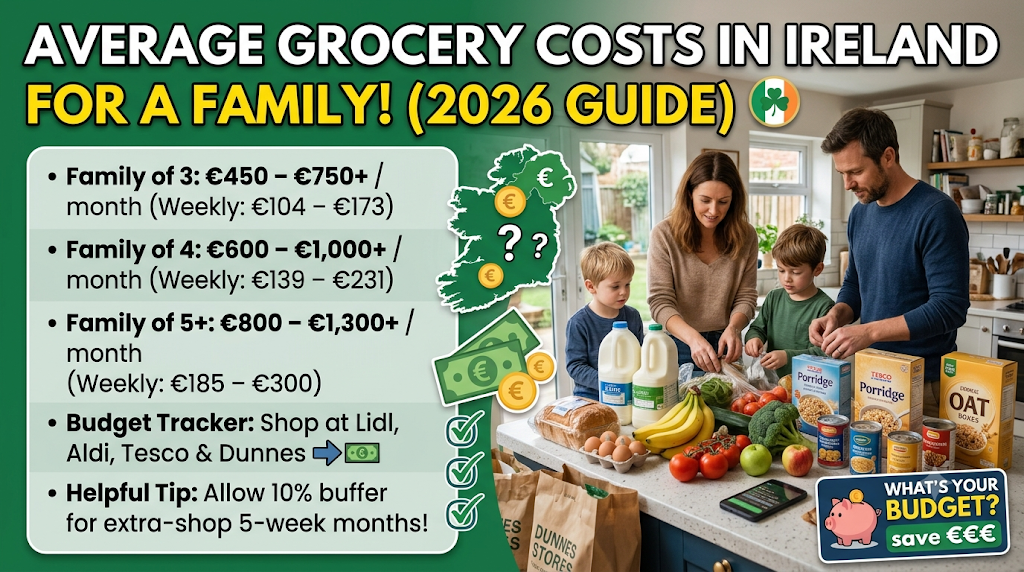
Planning a household budget in Ireland can be challenging when supermarket bills keep changing. Whether you are moving to Ireland, raising children, or trying to reduce your monthly expenses, understanding the average grocery costs in Ireland for a family can help you make better financial decisions.
Your grocery bill depends on the number of people in your household, their ages, your preferred supermarket, and the meals you prepare at home. A family that buys own-brand products and plans meals in advance may spend considerably less than a family that regularly buys premium brands, convenience foods, and snacks.
According to Ireland’s Central Statistics Office (CSO), the average household spent approximately €161 per week on food in 2023. Households with children spent an average of €203.46 per week across the broader food category measured in that survey. These figures provide an official historical benchmark, although they should not be treated as exact 2026 grocery prices. Central Statistics Office+1
Let’s look at realistic grocery budget ranges, what affects your spending, and how to make your food budget go further.
What Are the Average Grocery Costs in Ireland for a Family?
The average grocery costs in Ireland for a family vary depending on household size and shopping habits. For a practical 2026 budget, a family of four might plan around €110–€165 per week for a budget-conscious or balanced supermarket shop, while households buying more premium products may need more.
The following figures are planning estimates, not official national averages. Your actual costs may be lower or higher.
| Household size | Estimated weekly budget | Estimated monthly budget |
|---|---|---|
| 1 adult | €40–€70 | €173–€303 |
| 2 adults | €70–€120 | €303–€520 |
| 2 adults + 1 child | €90–€140 | €390–€606 |
| 2 adults + 2 children | €110–€165 | €476–€714 |
| 2 adults + 3 children | €135–€200 | €585–€866 |
Monthly estimates use 4.33 weeks per month. Figures are indicative budgets for food shopping and may vary by age, location, diet, and supermarket.
These ranges are intended to help with budgeting rather than guarantee what a particular family will pay. Recent supermarket basket comparisons and cost-of-living guides also show substantial differences between budget, standard, and premium shopping habits. MasterMarket+1
How much does a family of four spend on groceries?
For two adults and two children, an initial budget of approximately €475–€715 per month is a reasonable starting point for a carefully managed or balanced food shop.
However, several factors can push the total higher:
- Teenagers who eat larger portions.
- Special dietary requirements or allergies.
- Frequent purchases of branded products.
- School lunches, packed snacks, and drinks.
- Buying convenience meals instead of cooking from scratch.
- Shopping at more expensive supermarkets without comparing offers.
Remember that grocery costs are different from your total household food expenses. Restaurant meals, takeaways, and regular café visits may require a separate budget.
Weekly and Monthly Grocery Budget for a Family
Weekly shopping is often easier to manage because it gives you a clear spending limit. However, monthly budgeting helps you understand how groceries fit into your overall household expenses.
For example, a family of four could use this simple plan:
| Budget category | Weekly amount |
|---|---|
| Meat, fish, eggs, and other protein | €35 |
| Fruit and vegetables | €25 |
| Bread, rice, pasta, and other staples | €20 |
| Milk, cheese, and yoghurt | €20 |
| Snacks, breakfast items, and extras | €20 |
| Total | €120 |
This is an illustrative allocation, not a price-checked shopping basket. Actual costs depend on portion sizes, product choices, and what you already have in your cupboards.
At €120 per week, the estimated monthly grocery budget would be approximately €520.
To calculate your own monthly budget, multiply your weekly spending limit by 4.33. This is more accurate than multiplying by four because an average month is longer than four weeks.
What Affects Grocery Costs in Ireland?
Several everyday decisions can change how much your family spends at the supermarket.
1. Family size and children’s ages
A household with two young children may have different grocery needs from one with two teenagers. Older children often require larger portions, while babies may need formula, baby food, or other specialised products.
As your family grows, review your shopping budget instead of simply doubling your previous spending.
2. Your choice of supermarket
The supermarket you choose can affect the total cost of your weekly shop.
- Aldi and Lidl: Worth checking for budget-friendly own-brand groceries.
- Tesco: Offers a wide product range and loyalty-card prices on selected products.
- Dunnes Stores: Offers a mix of own-brand and branded groceries, with promotional offers on selected items.
- SuperValu: Provides a broad range of everyday groceries and local products.
- Marks & Spencer: May suit shoppers looking for premium products and speciality food.
No single supermarket will necessarily be cheapest for every item or every shopping trip. Compare the products you regularly buy, including any loyalty-card conditions, rather than relying entirely on general rankings.
3. Fresh food versus convenience food
Ready meals, pre-cut vegetables, individually packaged snacks, and takeaway food can increase your food spending.
Preparing simple meals at home can help reduce costs. For example, cooking a larger batch of soup, curry, pasta sauce, or stew can provide several portions for different days.
4. Dietary requirements
Vegetarian meals based on beans, lentils, chickpeas, rice, and seasonal vegetables can be economical. However, specialist gluten-free products, allergy-friendly foods, and certain high-protein products may cost more.
Choose meals that meet your family’s nutritional needs while making the most of ingredients you can buy affordably.
5. Food waste
Food that expires before you use it is money wasted. Buying too much fresh produce, forgetting leftovers, and shopping without a plan can all increase your weekly bill.
Check your fridge and cupboards before shopping, and plan meals around ingredients you already have.
How to Reduce Your Family Grocery Bill in Ireland
If your supermarket spending is higher than expected, you do not necessarily need to change everything at once. A few consistent habits can make a meaningful difference.
1. Plan meals before visiting the supermarket
Choose five to seven main meals for the week and list the ingredients you need. Check what you already own before adding items to the list.
For example, if you have rice, onions, and tinned tomatoes at home, you may only need to buy vegetables and a protein source for a simple dinner.
2. Buy own-brand products
Compare supermarket own-brand products with familiar branded alternatives. Rice, oats, pasta, tinned beans, flour, and frozen vegetables are useful places to start.
Check the price per kilogram or litre rather than comparing package prices alone.
3. Use frozen fruit and vegetables
Frozen produce can be useful when fresh alternatives are expensive or likely to spoil before you use them. It also allows you to take out the amount you need and keep the rest for another meal.
4. Cook meals in batches
Prepare larger quantities of dishes such as lentil curry, vegetable soup, pasta sauce, or stew. Refrigerate portions you will eat soon and freeze the rest safely.
Batch cooking can reduce waste and make it easier to avoid expensive last-minute meals.
5. Compare supermarket offers carefully
Special offers are useful only when they save money on something your family actually needs.
Before buying a discounted product, consider:
- Whether the regular price at another supermarket is lower.
- Whether you need the full quantity before it expires.
- Whether the offer requires a loyalty card.
- Whether a smaller package would be sufficient.
6. Create a weekly spending limit
Set a realistic budget based on your family size and dietary requirements. Track supermarket receipts for four weeks to identify your actual spending pattern.
If your initial limit is €140 per week, review where the money goes before reducing the budget. Cutting nutritious essentials simply to meet an unrealistic target is not a sustainable solution.
7. Keep a basic pantry
Keeping a small supply of long-lasting staples can help you prepare affordable meals without making extra shopping trips.
Useful items include:
- Rice and pasta.
- Oats and flour.
- Tinned beans and chickpeas.
- Tinned tomatoes.
- Frozen vegetables.
- Cooking oil and basic seasonings.
Buy pantry products gradually and avoid purchasing large quantities just because they appear cheaper per unit.
Sample Weekly Grocery Plan for a Family of Four
A practical meal plan helps you use ingredients across several dishes rather than buying separate items for every meal.
Here is an example for two adults and two children.
| Day | Lunch | Dinner |
|---|---|---|
| Monday | Egg sandwiches and fruit | Chicken, rice, and vegetables |
| Tuesday | Leftover chicken and rice | Lentil curry with rice |
| Wednesday | Vegetable sandwiches | Pasta with tomato sauce and beans |
| Thursday | Leftover pasta | Homemade vegetable soup and bread |
| Friday | Baked potatoes with beans | Homemade chicken or vegetable wraps |
| Saturday | Omelette and toast | Rice with mixed vegetables and protein |
| Sunday | Soup and sandwiches | Homemade stew with potatoes |
Breakfast can rotate between porridge, eggs, toast, yoghurt, and fruit, depending on your family’s needs.
This plan is an example rather than a nutritionally complete prescription. Adjust portion sizes and ingredients to suit your household, and include a variety of foods throughout the week.
To estimate the cost, create a shopping list with quantities, compare current supermarket prices, and check which ingredients you already have. That will give you a more reliable total than using a generic meal-plan price.
Grocery Shopping in Ireland: Budget Tips for New Residents
If you have recently moved to Ireland, the cost of everyday groceries may take some time to understand.
Start by comparing the prices of foods you buy regularly. You may find that familiar products from your home country cost more than locally produced alternatives.
A few practical tips can help:
- Explore nearby discount supermarkets before settling into a regular routine.
- Learn the difference between price-per-pack and price-per-kilogram labels.
- Check supermarket websites for current prices and offers.
- Consider frozen produce and seasonal vegetables.
- Keep supermarket spending separate from restaurant and takeaway spending.
- Allow some flexibility for household members with different food preferences.
Your location also matters. Shopping options and travel costs may differ between urban areas, smaller towns, and rural communities.
How Much Should You Budget for Groceries Each Month?
The right monthly grocery budget depends on your income, household size, and other essential expenses.
For a family of four, you could start with a budget of approximately €500–€700 per month and track your spending for a month. This is a starting range for planning, not a guarantee that it will cover every household’s needs.
Use the following steps to create a realistic budget:
- Review recent supermarket receipts, if available.
- Separate food purchases from toiletries and cleaning products.
- Identify regular purchases that could be replaced with cheaper alternatives.
- Set a weekly limit that covers suitable meals and snacks.
- Review the total at the end of each month and adjust it if necessary.
If your family regularly exceeds the budget, look at the reasons before making cuts. Rising prices, food allergies, school meals, and the needs of growing children can all affect what is realistic.
The goal is not simply to spend less. It is to provide suitable food for your family while keeping household expenses manageable.
Conclusion
The average grocery costs in Ireland for a family depend on household size, shopping habits, dietary needs, and supermarket choice. For a family of four, a starting budget of around €475–€715 per month can help with planning, although some households will need more.
The best way to control your grocery bill is to plan meals, compare unit prices, use ingredients efficiently, and track your actual spending. Start with a realistic weekly limit, make small adjustments, and review the results after a month.
Ready to lower your grocery bill? Create a shopping list for your next seven days, compare prices at nearby supermarkets, and build a food budget that works for your family.
Frequently Asked Questions
1. What is the average grocery cost in Ireland for a family of four?
A family of four might budget around €110–€165 per week for groceries, depending on its shopping habits and dietary needs. Premium products, convenience foods, and larger appetites can increase the total.
2. How much does a family of four spend on groceries per month in Ireland?
A practical starting estimate is approximately €475–€715 per month. Actual spending varies by supermarket, location, children’s ages, and the types of food purchased.
3. Which supermarkets are cheapest for groceries in Ireland?
Aldi and Lidl are good places to start when comparing budget-friendly groceries. However, Tesco, Dunnes Stores, and SuperValu may offer competitive prices on particular products or promotions. Compare your regular shopping basket before deciding.
4. How can a family save money on groceries in Ireland?
Plan meals in advance, buy suitable own-brand products, compare unit prices, cook in batches, and use leftovers. Avoid purchasing discounted items that your family does not need.
5. Is €100 a week enough for a family of four in Ireland?
It may be possible for a family with a carefully planned, budget-conscious diet, particularly if it already has pantry staples. However, €100 may not cover every family’s needs, so track actual prices and prioritise adequate, varied meals.
6. How much should a family budget for food each month?
The amount depends on family size and circumstances. A family of four could begin by testing a €500–€700 monthly grocery budget and adjust it after tracking receipts. Restaurant meals and takeaways should be budgeted separately.
7. Are groceries more expensive in Dublin than in other parts of Ireland?
Costs can vary by location, store availability, and shopping choices. Do not assume that every product is more expensive in Dublin; compare local supermarket prices and include travel or delivery costs when calculating the total.
8. How do I calculate my monthly grocery budget from weekly spending?
Multiply your weekly grocery spending by 4.33 to estimate an average month. For example, a €120 weekly budget works out to approximately €520 per month.